Available on every plan · Updated 14 September 2026
Also asked as: “which pages does my store have” · “where do I edit my about page” · “add a page” · “about us page” · “size guide” · “page title in google” · “delete a page” · “hide a page” · “page url” · “change the words on my home page” · “change the home page picture” · “home page banner” · “edit my slideshow”
Your storefront already has the pages it cannot do without: the home page, the product, collection and blog listings, About, Contact, your three policy pages, the cart and your customers' account area. Online Store → Pages lists them all on every plan, and each one opens a screen where you change its words and how it appears in search. On Professional and above you can add your own pages there too, and change any page's layout in the storefront editor.
See your pages
Go to Online Store → Pages.
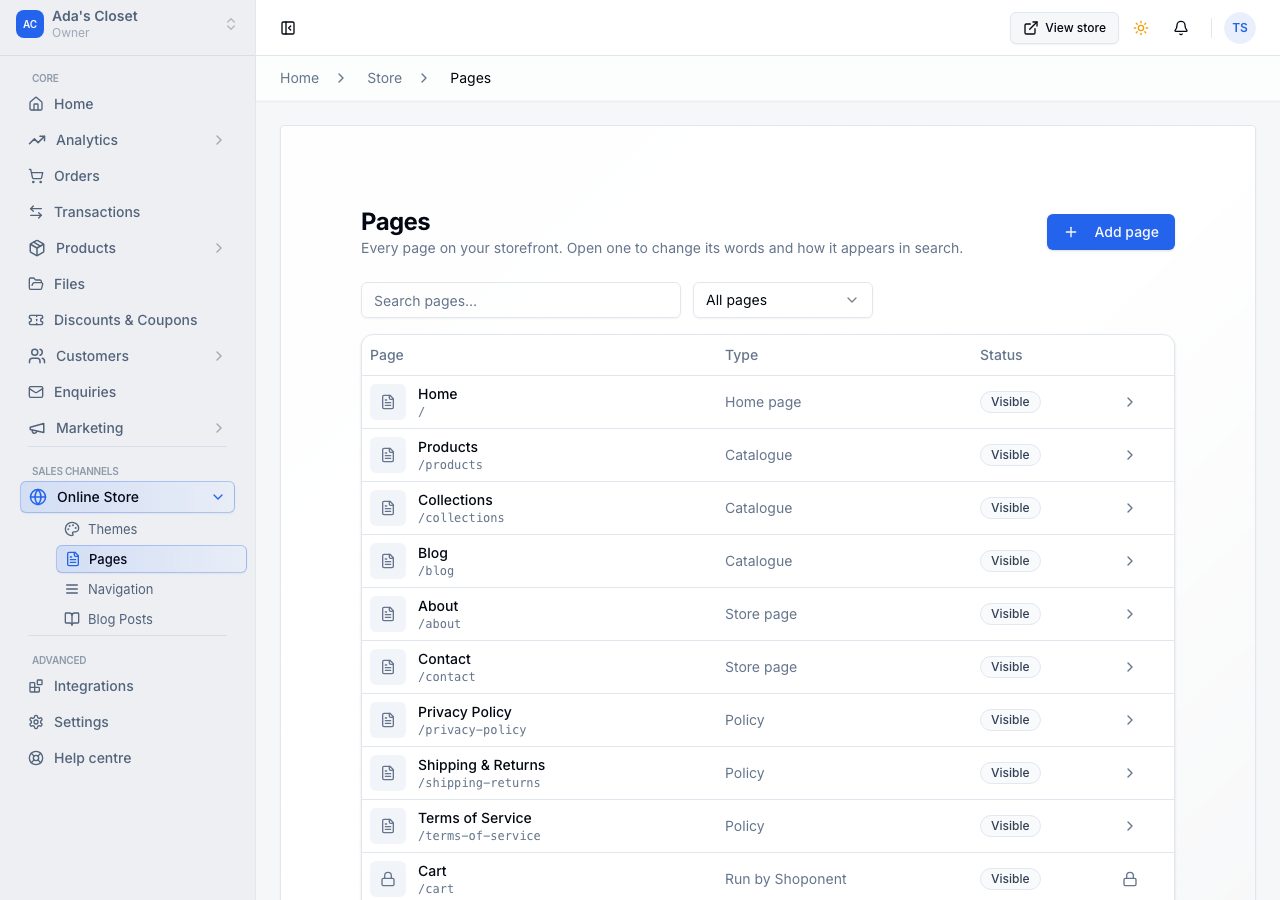
Each row is one page: its name, its address on your store, its Type and its Status. Choose a row to open the page. Search pages finds one by name or address, and the menu beside it shows all pages, only your store's pages, or only the pages you added.
- Home page, Catalogue (Products, Collections and Blog), Store page (About, Contact and any other page your theme gave you) and Policy are your store's pages. They are always on your storefront and cannot be deleted.
- Your page is a page you added yourself. Its ⋯ menu can Edit, Hide or Show it, and Delete it.
- Run by Shoponent marks the cart and your customers' account area, with a lock. We run those so checkout and sign-in work the same everywhere, so there is nothing on them to edit.
Visible means shoppers can open the page. Hidden is a page of yours you have hidden, and Not in your theme is a page your current theme does not include.
If you have not chosen a theme yet, the page says Your storefront has no theme yet and Choose a theme takes you to Online Store → Themes, because a theme is what gives your storefront its pages.
Change a page
Every page opens the same kind of screen. What you change is in the main column; the column on the right says whether shoppers can see the page and where its layout is changed.
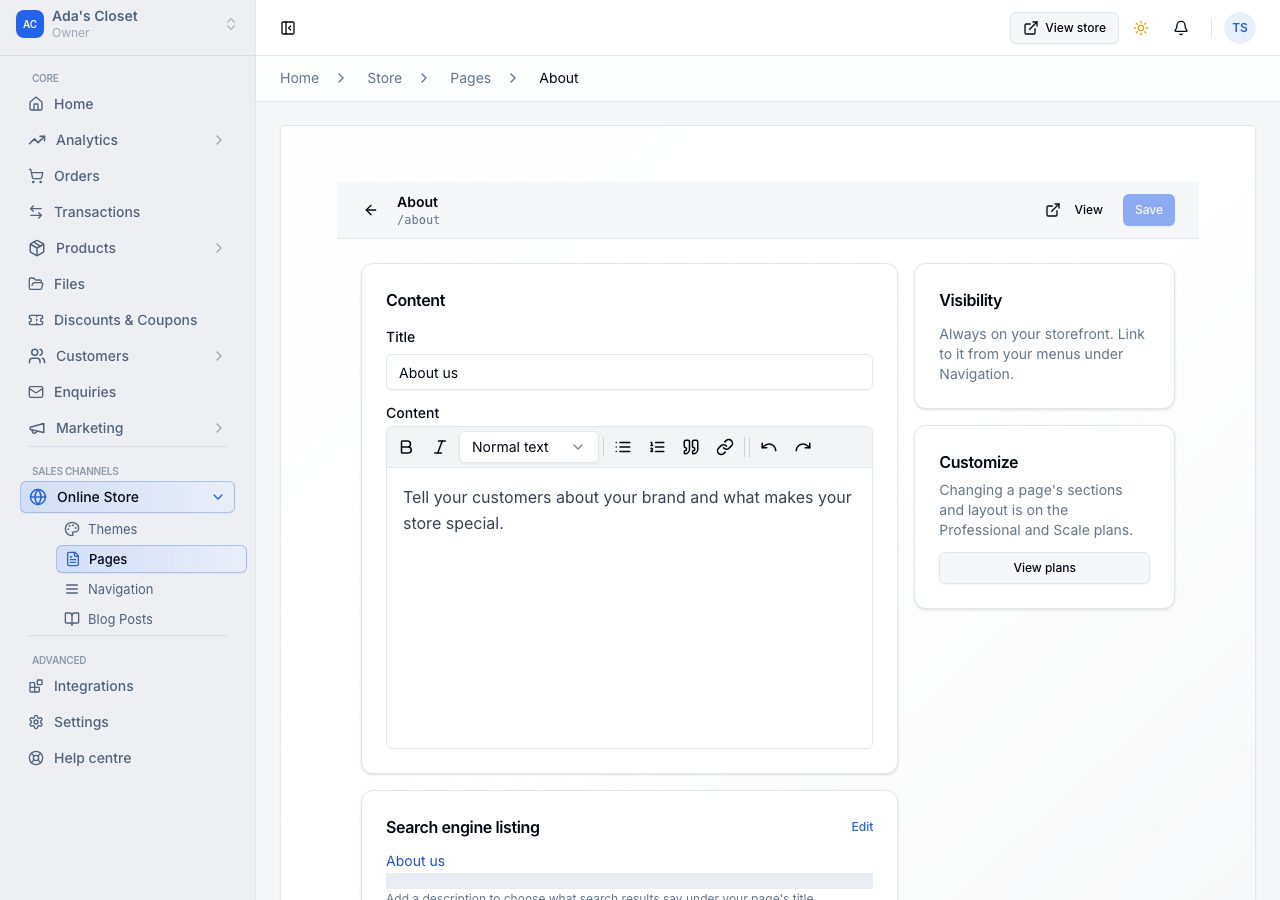
- Content holds the page's Title and its text, with headings, bold, italics, lists, quotes and links. About, the three policy pages and the pages you add have it.
- Save, at the top of the screen, saves everything on it at once. Unsaved changes shows while there is something to save, and Discard puts back what was saved. On a phone, Save sits at the bottom of the screen. Your storefront shows a save within a few seconds, with no separate publish step.
- Visibility says a store page is always on your storefront. A page you added has Visible and Hidden instead.
- Customize opens the storefront editor on this page, to change its sections and layout. On Starter it says which plans include that, with View plans.
What each page carries:
- Home: its hero, below.
- About: Content. Until you write it, it says the store has not written its About page yet.
- Contact: its words, the contact details it shows, and its form. See Your contact form and where messages land.
- Privacy Policy, Shipping & Returns and Terms of Service: Content, marked Not written yet until you replace the placeholder. See Your policy pages.
- Products, Collections and Blog: only their search engine listing, because what they show comes from your catalogue.
Applying another theme keeps About's text, Contact's words and details, your policy pages and your hero. See Choose a theme.
Change your home page's hero
The hero is what your home page opens on: a heading, a line of text, a picture and up to two buttons. Open Home from the list. The hero comes first, on every plan.
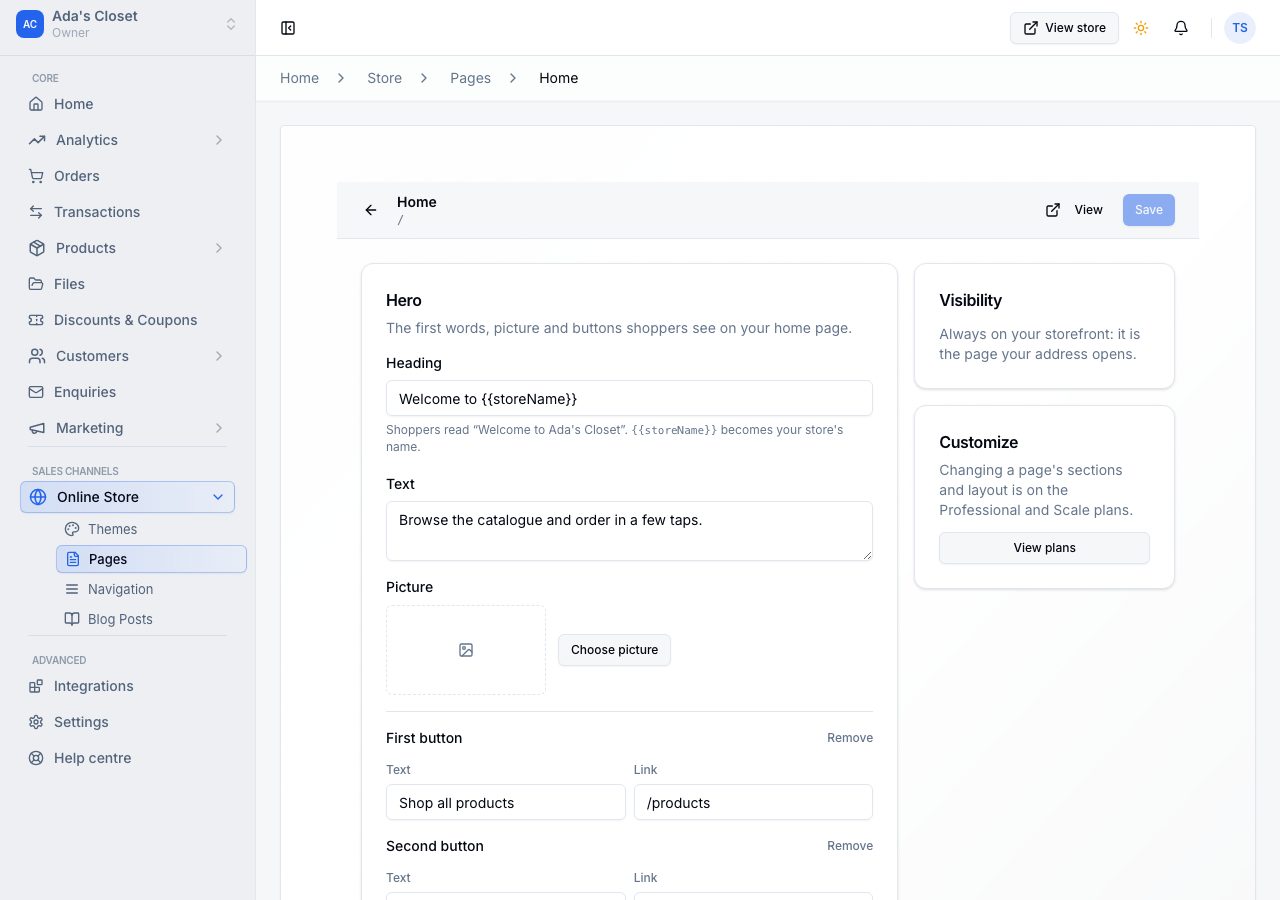
- Heading is the large line at the top. A hero always needs one.
- Text is the smaller line beneath it.
- Picture: Choose picture picks an image from your Files, Change swaps it, and Remove takes it off.
- First button and Second button each take a Text and a Link. The link is a page on your store starting with
/, such as/products, or a full web address. Fill in both or neither; Remove clears a button, and a button with both empty is not shown.
If the heading holds {{storeName}}, your storefront shows your store's name in its place. The line under the heading says what shoppers read, and it stays right if you rename your store.
If your home page opens on a slideshow, the card is called Hero slideshow, first slide. The fields are the same, and they change the first slide only. Adding, removing or reordering slides is done in the storefront editor, on Professional and above.
- The storefront editor changes this same hero, so a change in one place shows in the other.
- Applying a theme, or saving your brand colour, keeps these words, the picture and the buttons, as long as both themes open the home page the same way: both on a hero, or both on a slideshow. On a slideshow that is the first slide only: the other slides are storefront editor work, which applying a theme replaces like any other section.
- The picture is an image. A video cannot be chosen here.
- If your home page opens on neither, the card says so. Add a Hero section to the top of your home page in the storefront editor, or choose a theme whose home page opens on one.
How a page appears in search, and when it is shared
Every page's screen has a Search engine listing. It shows a preview of how the page might look in search results, and Edit opens the fields behind it.
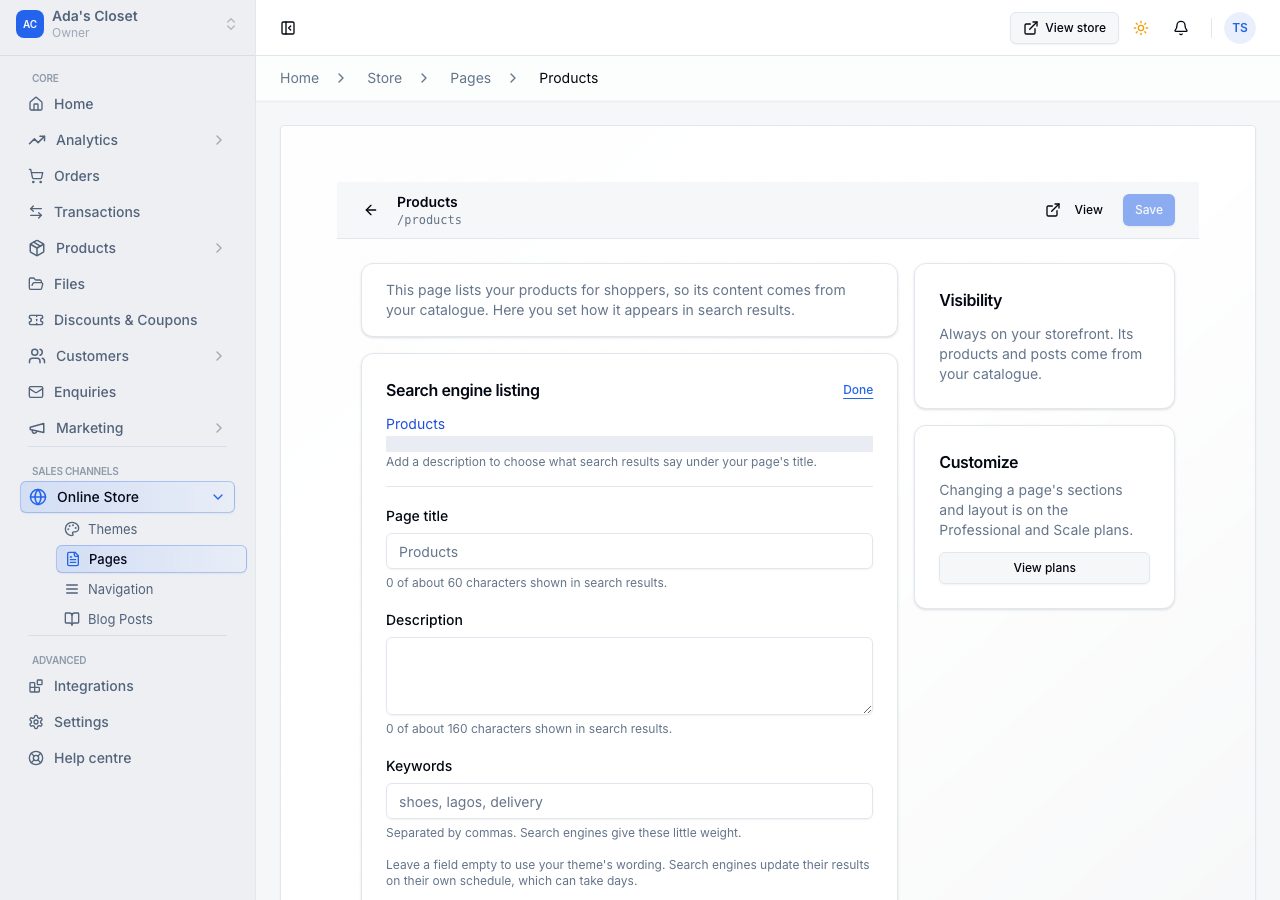
- Page title is the headline in search results and the name in a browser tab. Search results show about the first 60 characters.
- Description is the short summary underneath. Search results show about the first 160 characters, so put what matters first.
- Keywords, on your store's pages, separated by commas. Search engines give these little weight; the title and description matter more.
- Social sharing image, on Home: the picture a link to your store shows when someone shares it on WhatsApp, Facebook or X. Choose image picks one from your Files; a wide image about 1200 by 630 pixels works best.
- Page address, on a page you added: the last part of its address, after
/pages/.
Leave a field empty to use your theme's wording. The listing is saved with the screen's Save, and search engines update their results on their own schedule, which can take days. The storefront editor's Details on a page edits these same settings, so a change in one place shows in the other.
Add a page
On Professional and above, choose Add page at the top of the list.
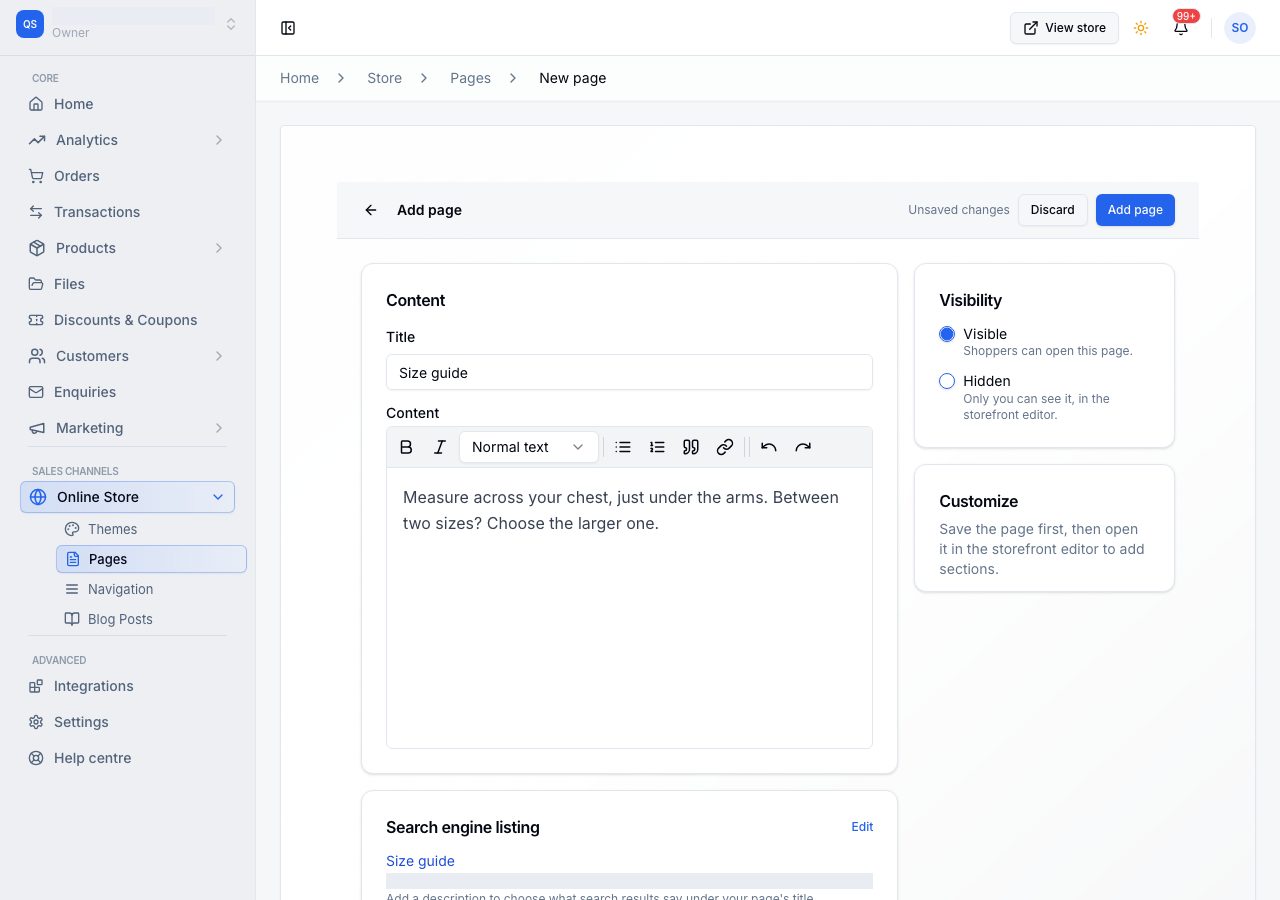
- Content: the page's Title and its text. You can also leave the text empty and build the page from sections in the storefront editor.
- Search engine listing: the page's address follows its title until you set one, so "Size guide" becomes
size-guide. Keep it short, lower case and joined by hyphens:about-us,size-guide,faq. Your store's own pages already have their addresses, soabout,contactand the policy addresses cannot be used again. Get it right first time, because a link someone has already shared stops working if you change it later. - Visibility: Visible puts the page on your storefront as soon as you add it; Hidden keeps it from shoppers.
Choose Add page. The page opens on its own screen, where Customize now opens it in the storefront editor. Put a link to it in your header or footer under Navigation: a page nobody can reach is a page nobody reads.
A page you built from other sections in the storefront editor has no text box here. Its Content card says it is changed in the editor, with a button that opens it there.
Delete page, at the bottom of a page you added, asks you to confirm and then removes it for good. Links to it stop working.
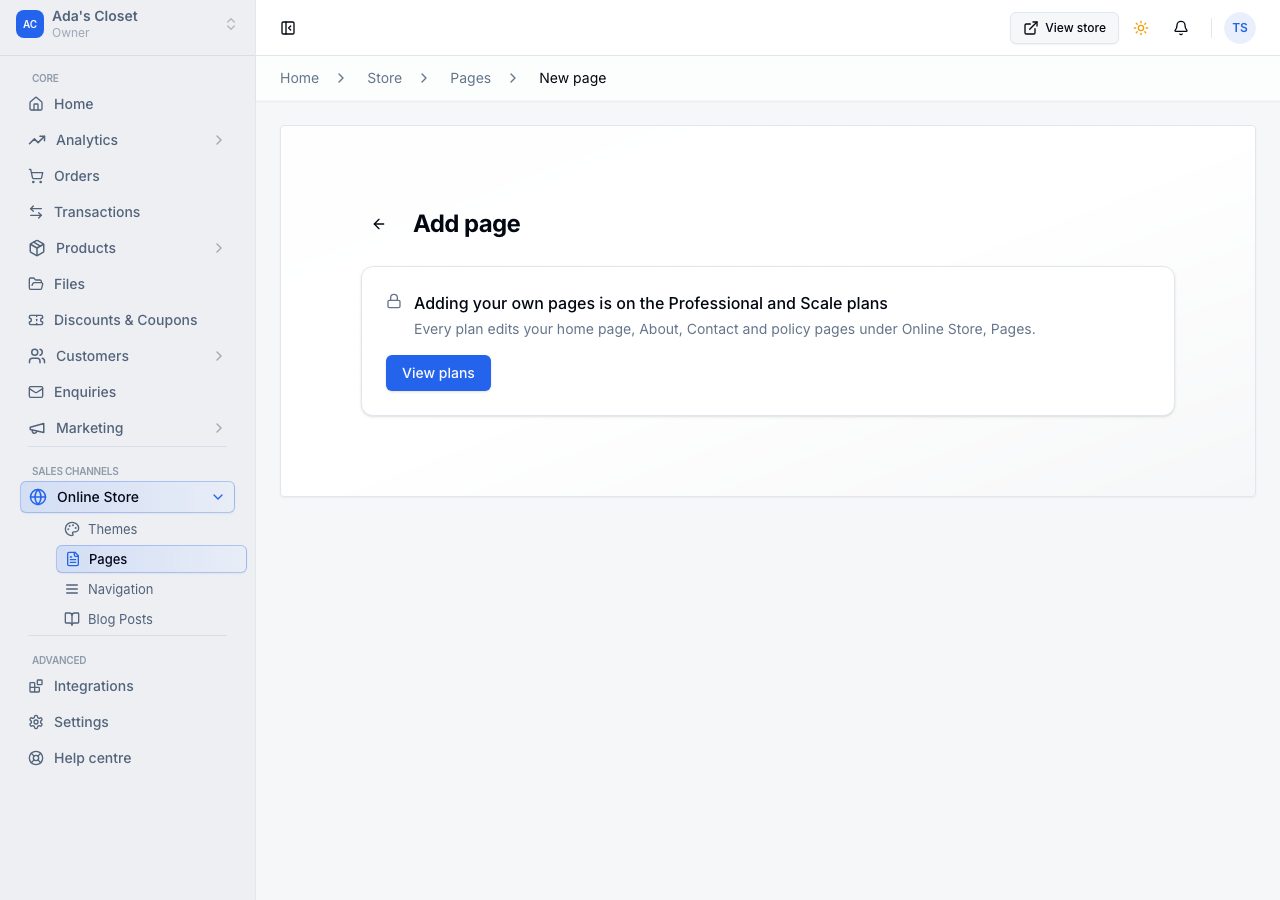
On Starter, Add page says which plans include it:
Pages in the storefront editor
On Professional and above, the storefront editor has its own Pages panel too, where you add pages and edit any page's sections. Open the storefront editor from Online Store → Themes → Customize, or from Customize on a page's screen, then choose Pages in the left-hand column. See the pricing page for what each plan includes.
What is in the editor's list
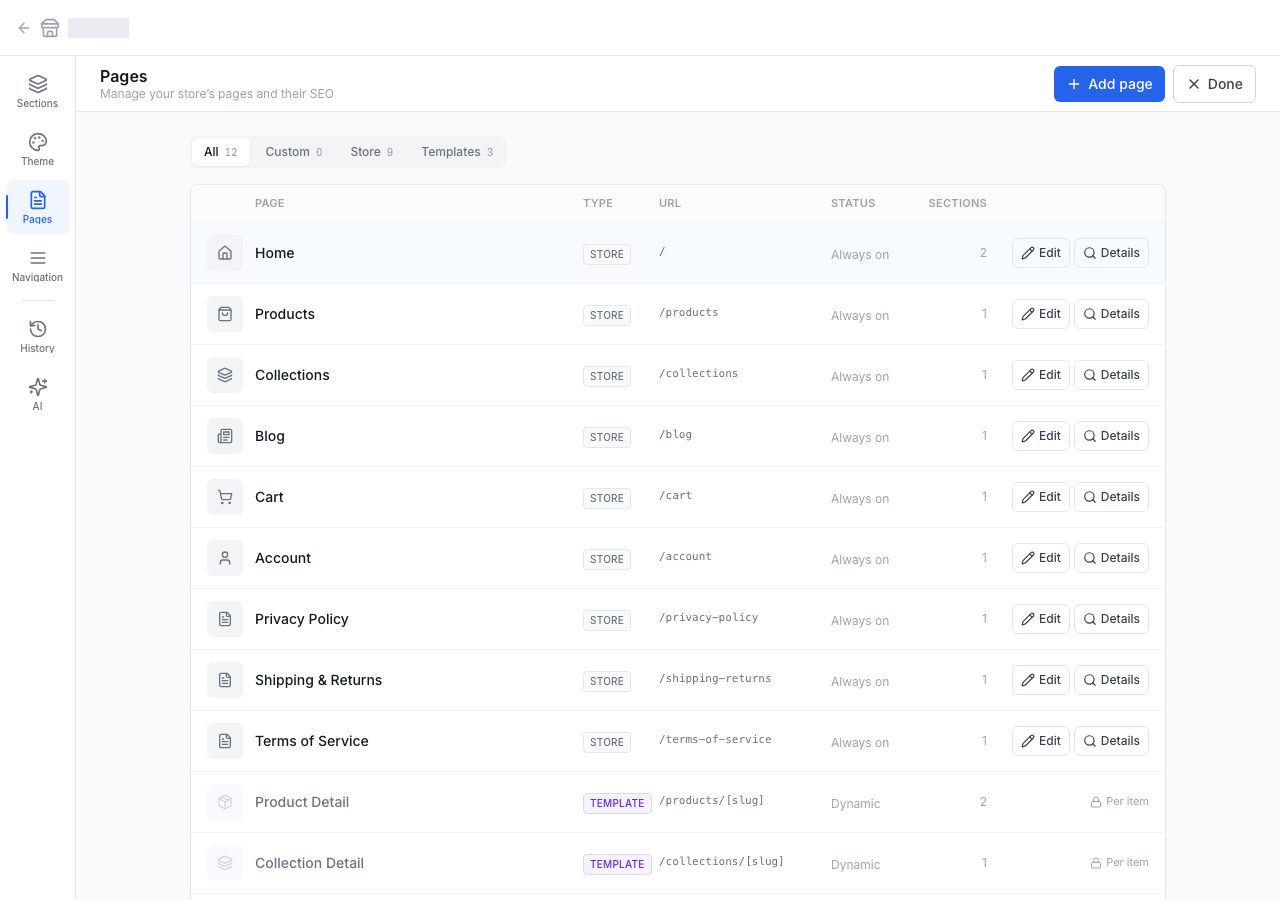
The tabs at the top count three kinds, and they behave differently:
- Store pages are the ones your storefront cannot do without, listed as Always on. You can edit what is on them and how they appear in search, but not their address, and you cannot delete them. About, Contact and your three policy pages are here.
- Custom pages are yours. They live under
/pages/, you choose the address, and you can unpublish or delete them. - Templates are the layouts behind pages that exist once per item, such as a product page or a collection page. They are marked Dynamic and Per item: you edit the template once and every product or collection uses it.
Each row says how many sections the page has and gives you two actions, Edit and Details.
Adding a page in the editor
Add page in the editor asks for a Title and a URL slug, the same address rule as above.
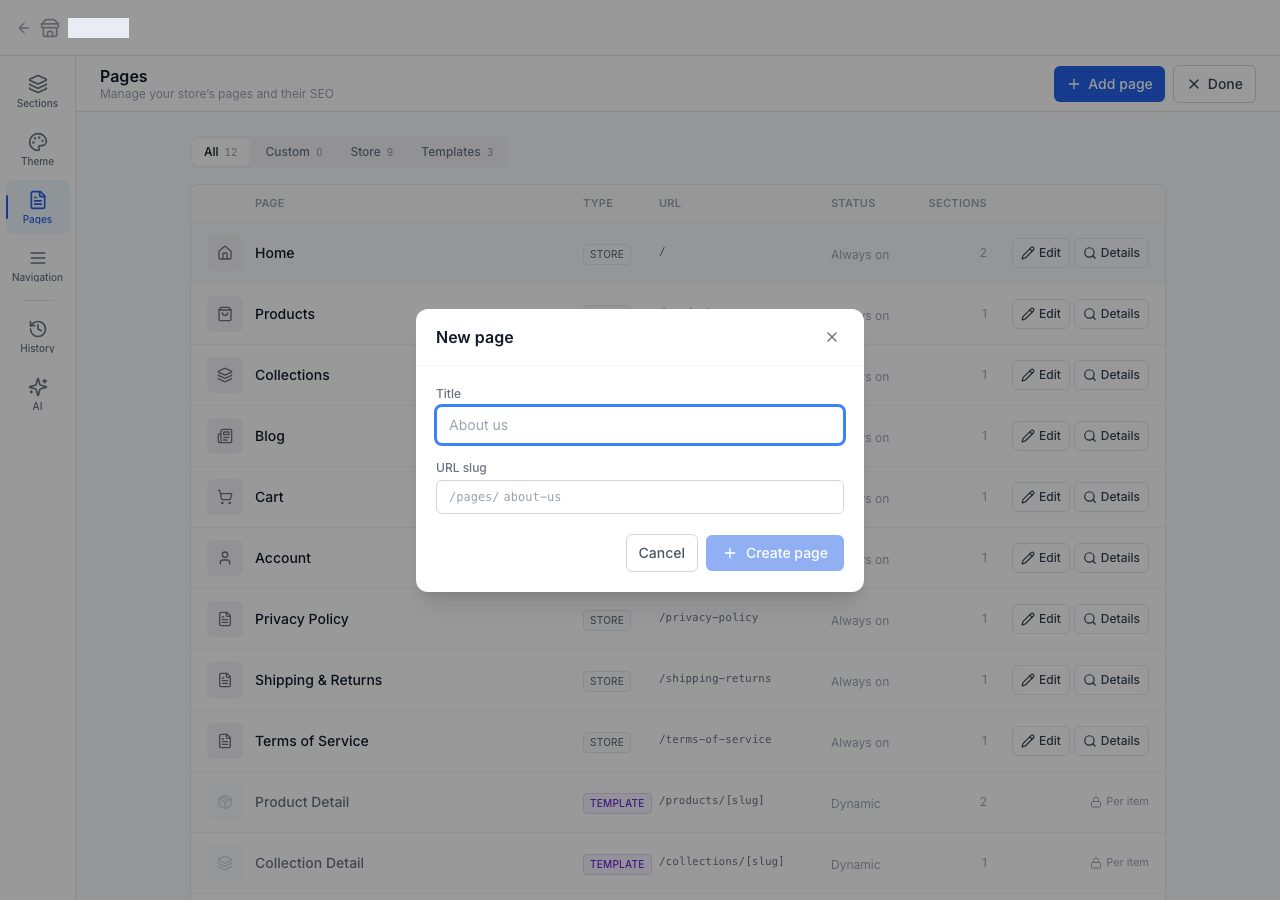
Choose Create page, then Edit opens it in the editor's Sections view, where you add sections and write into them. Section edits ride the editor's Publish, the same as any other page.
Details in the editor
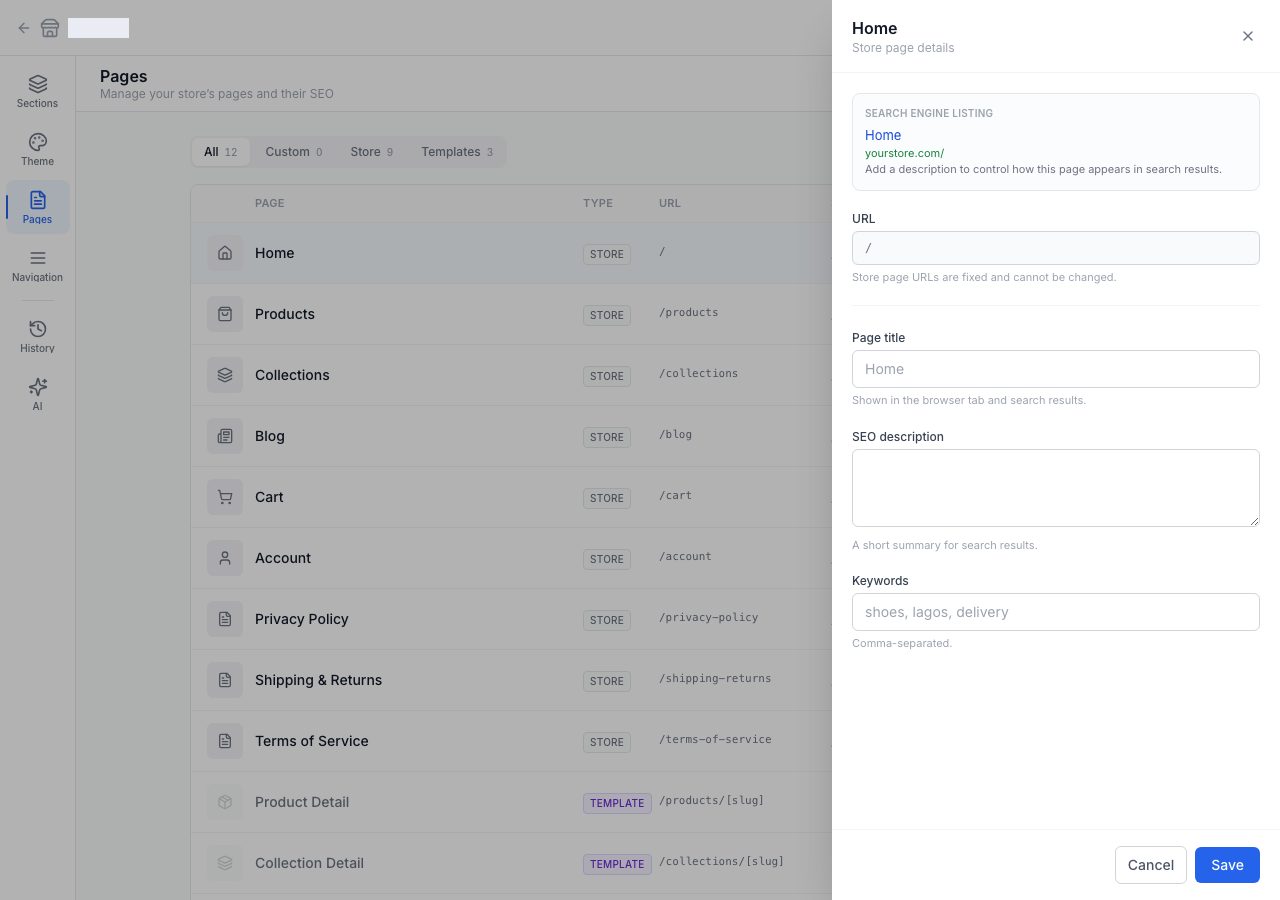
Details opens everything that is not the page's content: a preview of the search engine listing, the URL (editable for a custom page, fixed for a store page), the Page title, the SEO description and Keywords.
If it does not work
- Add page shows a plan card. Adding your own pages is on Professional and above. Every plan edits its home page, About, Contact and policy pages.
- Save stays greyed out. Nothing has changed yet, or something cannot be saved: an empty title, a page with no text, a hero button with its text and no link (or the other way round), or an address that is not allowed. The message on the screen says which.
- Your new page is not on the storefront. It is Hidden, or nothing links to it. Check its status in the list, then add it to a menu.
- You cannot change a page's address, or delete it. It is one of your store's pages. Only a page you added has an address you own and can be deleted.
- You renamed a page's address and links broke. Old links to the old address stop working, and nothing redirects them yet. Put the old address back if the links matter.
- You want to change the slideshow's second slide. A page's screen changes the first slide only. The other slides are in the storefront editor, on Professional and above.
- A page says it is built from sections. Its content lives in sections, so change it in the storefront editor with Customize.
Email support@shoponent.com with your store name if anything here does not match what you see. We read and answer every message.